Build and report
Scope 1, 2 and 3 inventory, supplier data, filing, and the carbon accounting software if your team has none.
Advisory firms, specialists, platforms with services
Before you go
One sharp email on procurement markets — what moved, why it matters, what to do about it. Daily or weekly. Unsubscribe anytime.
Zinit Categories Sustainability and ESG
Sustainability and ESG procurement
California, Brussels and the SEC have each moved since most of these proposals were written, so the one on your desk may price a report you no longer owe and skip the assurance you do. Zinit's AI agents read every bid onto one sheet of your own obligations, by legal entity and year, and they keep the firm that builds your inventory apart from the firm that signs it, so your team awards on work it needs.
One company's obligations, read on November 6, 2026
A US building-products manufacturer: $2.18B revenue (the lesser of its last two years), $210M of California sales, €142M of EU turnover through a 410-person Dutch subsidiary, listed in New York.
| Rule and its test | Reads |
|---|---|
| California SB 253, Scopes 1 and 2Over $1B revenue and doing business in California | OwedFirst report November 10, 2026 |
| California SB 253, Scope 3The same test | Owed from 2027Five categories proposed so far |
| California SB 261, climate risk reportOver $500M revenue and doing business in California | On holdEnjoined by the Ninth Circuit pending appeal |
| EU CSRD, as amended in February 2026Over €450M EU turnover, plus an EU subsidiary or branch over €200M | Not owed€142M and 410 staff are under both tests |
| SEC climate rulesA listed company | Not in effectStayed since April 2024, rescission proposed in June 2026 |
| California AB 1305Buying offsets or claiming net zero in California | If claimedWebsite disclosure, refreshed every year |
A scope written in 2024 assumed the SEC's rules, the original CSRD thresholds and a California risk report due in January 2026, and each of those has changed. California set its first emissions report for November 10, 2026, so the first sourcing step in this category is reading the calendar on your own legal entities.
CARB's March 2026 workshop gave the one public per-company figure a CFO can hold a proposal against. Staff adapted it from the SEC's rulemaking, including a survey of 39 corporates, and said in July that some commenters called it low on Scope 3 and assurance while others called it high, so treat it as a reference point and let the bids set the price.
Averaged over three years across its Scope 3 options, staff put the annual figure at $135,083 to $152,352, with the first year at $167,102 to $191,391.
The survey behind that work is ERM's, of 39 issuers in early 2022, and the SEC's release reports its averages as $237,000 a year on GHG analysis and disclosures and $82,000 on assurance and audits, which makes a useful upper reference.
One more public anchor for the consulting line: on GSA's schedules, the 11 labor categories with sustainability in the title carry ceiling rates from $88.20 to $219.04 an hour, median $139.18, read on November 6, 2026. A ceiling on federal work is lower than most commercial rate cards, so use it to ask what the difference buys.
Each is one bid's leveled total plus the assurance lot, over three reports. Bid C, with 38 sites and software, sits at 1.77 times CARB's figure and below the $319,000 a year those two ERM averages add up to, and that spread is the thing to ask each bidder to explain.
Consolidating spend is the first lever in most categories, and in this one it runs into the rules. SB 253 asks for an independent third-party assurance provider, and CARB staff propose reading independence through the standard the engagement uses. So the proposal that bundles the build and the assurance can look cheapest and still leave you hiring and reconciling a second firm once somebody reads it closely.
Scope 1, 2 and 3 inventory, supplier data, filing, and the carbon accounting software if your team has none.
Advisory firms, specialists, platforms with services
Limited assurance on Scopes 1 and 2 from 2027, with reasonable assurance from 2030 priced as an option. The buyer carries the fee on this lot, under the election in the terms, so no bidder pays to win.
CPA firms, verification bodies
SB 261's risk report and a CSRD report, each priced and left unexercised until a rule or a customer requires it.
Whoever wins Lot 1, or a separate bid
CARB's Mandatory Reporting Regulation is a different program from SB 253, and its rule for verifiers is the plainest published list of what compromises one. It treats the conflict as high where anyone on the team did any of these for the company in the previous five years:
Ask each Lot 2 bidder to answer that list in writing, whichever standard it works to, since a firm that has to withdraw in month ten is the delay this category hides.
The SEC's 2022 proposing release estimated $75,000 to $145,000 a year for limited assurance at a large accelerated filer, median $110,000, and $115,000 to $235,000 for reasonable assurance, median $175,000, and warned that assurance on emissions may differ from the financial statement work those figures were built from. CARB was still asking companies what the difference costs in August and September 2026, so the fair way to learn it is to have every Lot 2 bidder price 2030 as an option now.
If your financial statement auditor bids, your audit committee has to pre-approve that service under Regulation S-X, and it weighs that firm's other work. Audit firms performed 59% of sustainability assurance engagements worldwide in 2024, by IFAC's count, so both kinds of firm belong on the list.
SB 253 allows industry-average and proxy data, so a spend-based estimate is legal and often sensible in year one. The two prices stop being comparable when one includes data your team would otherwise chase and an evidence trail an assurer can test, and the other does not.
| Hold constant | Bid A | Bid B | Bid C |
|---|---|---|---|
| Boundary | Operational control | Not stated | Operational control |
| Scope 3 categories | 1, 3, 5, 6, 7 | 1 and 6 | 1, 3, 5, 6, 7 |
| Method in category 1 | Hybrid, 60 suppliers' data | Spend-based only | Hybrid, 60 suppliers' data |
| Emission factors | Named, with vintage | Consultant's workbook | Named, with vintage |
| Who chases suppliers | The firm | Your team, 8 hours each | The firm |
| Evidence an assurer can test | In the software | Not in the bid | In the software |
| Reports covered | 3 | 3 | 3 |
| Recalculation | Included | 240 hours at $225, extra | Included |
Few platforms publish a price, so buyer data is the nearest thing. Vendr reports the median Watershed buyer at $70,031 a year, from $20,619 to $158,138, read on November 6, 2026, and a UK museum group's December 2025 notice for carbon accounting software with an audit trail and consultancy carried a £90,000 contract value. The example's $60,000 and $72,000 a year sit around that median, and what each figure includes is the question to ask.
CARB staff propose treating your first report as the base year and recalculating earlier years when method changes move the total by more than 5%. In this inventory, moving category 1 from spend data to supplier data does exactly that.
62,000 tonnes moved out of 797,000 tonnes is 7.8%, over the 5% line, so every earlier year is recalculated and shown again. Bid B prices that at 240 hours and $225, or $54,000, and the bill grows with each year already filed.
Even Scope 2 has a line to fix. CARB's guidance notes EPA has not released eGRID 2024 on its usual timeline and lets you use eGRID 2023 or a Cornerstone dataset built from EPA's code, so each bid says which it used.
The tonnes on these three lots read the same on a purchase order and support very different claims. Each row is something a buyer can check at the registry or on the seller's website, and California's AB 1305 now puts most of them on your own website the moment you claim net zero or carbon neutral with them. CARB staff also propose that credits are reported apart from Scopes 1, 2 and 3, so none of this lowers the inventory number.
| Lot 1 | Lot 2 | Lot 3 | |
|---|---|---|---|
| Project type | Grid-connected wind | Reforestation | Biochar |
| Removal or avoidance | Avoided emissions | Removal | Removal |
| Methodology | ACM0002, grid-connected renewables | VM0047, reforestation | U.S. and Canada Biochar |
| Under the Core Carbon Principles | Does not meet | CCP-approved | CCP-approved |
| Vintage | 2019 | 2024 | 2025 |
| Durability the seller states | Not applicable | 40 years, with a buffer | Over 100 years |
| Retirement record | Serial range, in your name | Serial range, in your name | Serial range, in your name |
| Published average price per tonne | $1.65 | $24.00 | $164.00 |
| 10,000 tonnes | $16,500 | $240,000 | $1,640,000 |
Each price is a published average: Sylvera's renewables of 2018 and 2019 vintages at $1.65 and reforestation of 2024 vintage at $24.00, both Q3 2026, and its 2025 biochar average of $164.00. The Integrity Council reports CCP-labeled credits at about a 25% premium, on ClearBlue Markets and Calyx Global data.
Procurement runs the event, and four other desks can stop it, each for a reason a price cannot answer.
Can veto
Holds it up when
A filing, a website claim or an offset purchase says more than the evidence behind it, or the sheet reads a rule the way counsel does not.
Wants to see
The sheet itself, each rule with its date and status, and every public claim mapped to the record behind it.
Can veto
Holds it up when
The financial auditor is among the bidders, because the committee has to pre-approve the service, or an assurance firm would be reviewing work it built.
Wants to see
Each firm's independence statement, its prior work for you over five years and its fees, side by side in one record.
Can veto
Holds it up when
The method will not survive year two: a boundary nobody wrote down, factors nobody can name or a supplier program the firm will not run.
Wants to see
Method by Scope 3 category, factor sources and vintages, how a recalculation is priced, and who the named people are.
Signs
Holds it up when
The total moves after award, or emissions data sits outside controls finance would recognize, which matters more once reasonable assurance arrives in 2030.
Wants to see
Three reports leveled by lot, the price of each option, and what changes if CARB changes the rule.
A 103M+ supplier and company database, AI agents that build the sheet and run the bidding, and procurement people who work beside your team.
Zinit reads your current proposals and contracts along with the revenue, sales and headcount you give it by legal entity, and it sets out each rule's test, date and status as a sheet, with its reading date. Your counsel corrects it, because whether a rule applies is counsel's call, and nobody is invited until your team has signed off.
One sheet every bid prices
Build, software and assurance go out separately, each with the same lines. The incumbent and the firms your team approves are invited, drawn from a 103M+ supplier and company database, and each assurance bidder answers in writing on independence and prior work for you.
A field your audit committee can read
The first RFP is drafted in under an hour, and your team then settles the scope; the bids take the time they take. Each proposal is read onto the sheet, so a line nobody owes comes out, a line left out is priced, and your team sees where every figure came from before it awards.
Three reports on one total
Sometimes the incumbent is still the right firm, and then your team renews at the price the bids set. Zinit does not give assurance, tell you whether a law applies, advise on your claims, or hold, sell or retire credits, and your team directs and approves every step.
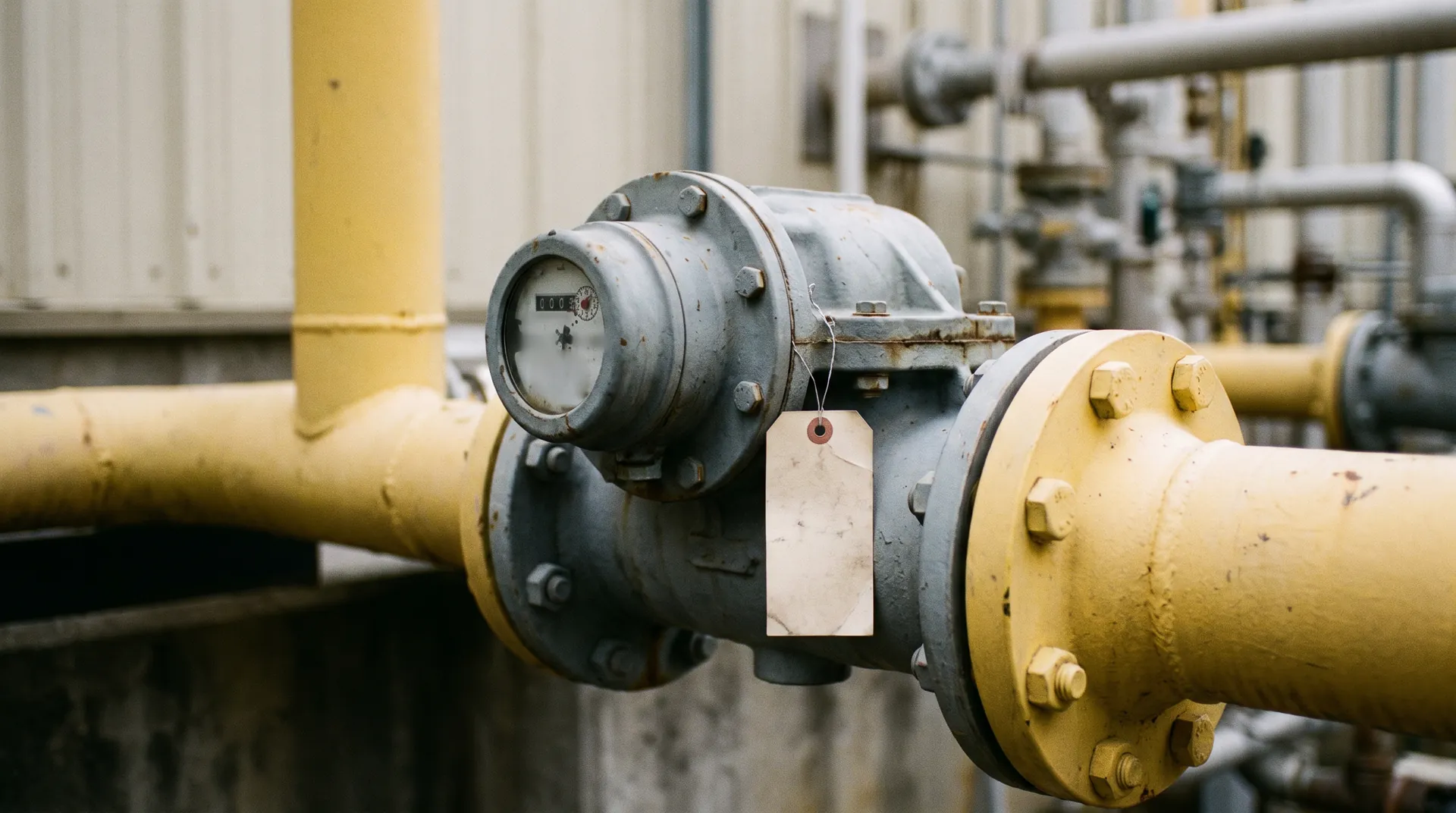
Every Scope 1 number starts at a meter like this one, and the assurer will ask who read it, when it was last calibrated and where that record lives.
The walkthrough
Every figure on this tab prints its basis.
CARB tests revenue and doing business at the individual entity, on the lesser of the last two fiscal years, so the group's headline number is the wrong place to start. For this company:
Every bidder prices these lines for the reports due in 2027, 2028 and 2029, so three firms stop answering three different questions.
| Line | Basis every bidder prices | Lot |
|---|---|---|
| Scope 1 and 2 inventory | 38 sites, 3 reports | 1 |
| Scope 3 inventory | 5 categories (1, 3, 5, 6, 7 as proposed), 3 reports | 1 |
| Supplier data | Top 60 suppliers by spend, 3 reports | 1 |
| Carbon accounting software | 3 years, evidence an assurer can test | 1 |
| Filing with CARB | 3 reports | 1 |
| A base-year recalculation | One instance if method changes pass 5% | 1 |
| Limited assurance, Scopes 1 and 2 | 3 reports, independent of Lot 1 | 2 |
| SB 261 report and CSRD report | Priced, not exercised | Option |
Your team approves the list before anyone is contacted, and nobody sees another firm's price or your current fees.
Lines nobody owes come out, lines left out go in at the bidder's own rate or the lowest on the tab, and the basis of each figure stays printed.
| Three reports | Bid A: the incumbent | Bid B: boutique | Bid C: specialist |
|---|---|---|---|
| Scope 1 and 2 inventory | $182,400 | $102,600 | $136,800 |
| Scope 3 inventory | $255,000 | $142,500 | $180,000 |
| Supplier data | $117,000 | $136,800 | $81,000 |
| Software | $216,000 | $180,000 | $180,000 |
| Filing with CARB | $45,000 | $24,000 | $30,000 |
| One recalculation | Included | $54,000 | Included |
| Leveled on the sheet | $815,400 | $639,900 | $607,800 |
| As quoted | $1,467,400 | $183,600 | $607,800 |
| Own assurance, moved out | −$204,000 | — | — |
| CSRD report, not owed | −$344,000 | — | — |
| SB 261 report, on hold | −$104,000 | — | — |
| Left out, priced in | — | +$456,300 | — |
Bid A: the incumbent
Bid B: boutique
Bid C: specialist
Bases: Scope 1 and 2 at 38 sites × $1,600, $900 and $1,200 a site a year × 3. Scope 3 at $17,000, $9,500 and $12,000 a category a year; Bid B priced 2 categories, and the other 3 go in at its rate. Supplier data at 60 suppliers × $650 and $450 a year × 3; Bid B leaves this to your team, 60 × 8 hours × $95 × 3. Software at $72,000 and $60,000 a year; Bid B has none, so the lowest on the tab goes in. Filing at $15,000, $8,000 and $10,000 a year. Bid B's recalculation is 240 hours × $225. Bid A's assurance is $68,000 a year × 3, its CSRD report $140,000 for double materiality plus $68,000 a year × 3, and its SB 261 report $52,000 × 2.
Two firms bid on the same scope, with 2030 priced as an option, and Bid A's assurance arm stays eligible only if Bid A does not win Lot 1.
| Lot 2, three reports | Firm X: CPA firm | Firm Y: verification body |
|---|---|---|
| Standard | AICPA AT-C 210 | ISO 14064-3:2019, accredited |
| Hours a year | 260 | 220 |
| Rate | $285 | $225 |
| Three reports | $222,300 | $148,500 |
| 2030 reasonable assurance, option | 420 hours, $119,700 | 360 hours, $81,000 |
| Audit committee step | Pre-approval, since it audits the financials | Reads the independence answer |
Hours and rates are the example's. Firm Y's written answer shows no prior work for this company in five years, and Firm X's shows no inventory work, so both can sign. The options sit near the SEC's estimated ratio of reasonable to limited, and assume the controls in the winning software, which is why Lot 1 is awarded first.
The tab goes to the four desks with the sheet behind it, and SB 261 and CSRD stay priced and unexercised.
Your team awards. Zinit records the award, the leveled tab and each firm's answers.
VERIFIED BENCHMARKS
| Category / Lever | Savings Range |
|---|---|
| Sustainability advisory and consulting | 15-25% |
| ESG reporting and assurance services | 12-20% |
| Carbon accounting platforms | 15-25% |
| Supply chain sustainability auditing | 12-22% |
| Renewable energy advisory and PPA structuring | 10-18% |
A company of any size usually buys from several of these rows, and some firms appear in more than one, which is the independence question in another form. Specialists near your sites and your sector are invited from the database, so they do not appear here by name.
limited and reasonable assurance on emissions, from CPA firms and verification bodies







inventories, strategy, risk reports and program support


software that holds the inventory and its evidence


supplier scorecards, questionnaires and site audits





where a credit is issued and retired, and who rates it





Established suppliers in each category, shown to illustrate the market, not as a list of Zinit's customers or partners.
A mining customer's result across its recent RFPs and the logo row from the homepage, both as the rest of the site shows them.
Saved over 12% across 28 recent RFPs
A mining customer's recent RFPs, across its categories. The customer is not named.
RFPs published from






As shown on the homepage.
Zinit is supplier-funded and free to buyers: only the supplier your team selects as the winner pays a commission, the losing bidders pay nothing, and nothing is owed until you award. The commission rates are published openly on our site, and because the fee is tied to the award your team makes rather than to who competes, Zinit earns the same whichever qualified supplier you choose.
It can, which is why the tab compares every bid on one sheet, so whatever a bidder has built in shows in its number. It is also a small figure, since under the fee schedule in Zinit's terms of service an award the size of Bid C's $607,800 carries a $1,875 flat fee plus 0.125% of the RFP volume, about $2,600 once, or about $880 a report over its three reports. If your CFO would rather keep it out of the bids altogether, the same terms let the buyer elect to carry the fee when the RFP is published.
It may not be able to, so read this one with counsel. California's Business and Professions Code section 5061 says a person in public accountancy shall not pay a fee or commission to obtain a client, and the AICPA Code asks a member who pays a referral fee to disclose it to the client. The clean route on an assurance lot is the election in the terms, where the buyer carries the fee when the RFP is published, so no bidder pays anything to win.
No, that is your counsel's call. Zinit sets out each rule's test and date against the numbers you give it, with the date it read them, and your counsel corrects the sheet before any firm sees it.
Only what your team approves goes out in the invitation. Your inventory data, current fees, the other firms' bids and anything counsel marks as privileged stay with your team, and bidders see the same sheet of lines. Your security team will want the details of storage and retention in writing, so put that to us in the demo and hold us to the answer.
Zinit runs the sourcing event for companies that buy this work. It claims no assurance or broker license, it does not hold, sell or retire credits, and it does not tell you what you can claim.
It can bid like anyone else, and your audit committee has to pre-approve the service. Bidding it gives the committee a price and a second reading of the scope, and if your auditor is still the best answer your team can award it knowing that.
Expect it to, since the regulation is still proposed. The sheet prices each line on a stated basis, such as a rate per Scope 3 category, so a change to the list of categories reprices at the rate already on the tab and is not a fresh negotiation. Your counsel decides what the change means, and your team decides whether to take it.
Sometimes, and it depends what your team can staff. In the example a platform-led bid wins, and with your own platform and analysts already in place the boutique wins, and the tab shows both.
Some will not, and your team sees who declined and what they said. A firm with a long relationship may resist a structured comparison, so the invitation says plainly that advisor credibility and named people are scored beside price.
Not yet, and we would rather say so. The results we can show come from other categories, so the fair way to test this is one lot, such as the assurance on your next report, before anything bigger.
Bring the proposal, your entity list and whatever your last report used. Zinit builds your sheet, runs the lots and levels the bids over three reports, with your team directing and approving every step.