



Saved over 12% across 28 recent RFPs
A mining customer's recent RFPs, across its categories. The customer is not named.
Before you go
One sharp email on procurement markets — what moved, why it matters, what to do about it. Daily or weekly. Unsubscribe anytime.

Zinit Categories HR and contingent labor
Contingent labor procurement
A markup is a percentage of a pay rate the bidder picked, so two temp staffing agencies can quote close markups and bill very different hours. Zinit's AI agents put every bid on your own pay card, by job family and site, with statutory burden, program fees and margin shown apart, and they price your overtime, wage floors and conversions, so your team awards on a year of real hours.
One line of the rate card, three bids
Forklift operator at a Joliet, Illinois warehouse. Dollars per straight-time hour.
As quoted
On your pay card, $21.50 for everyone
Since January 2020 average hourly earnings in temporary help services have risen 43.5% while the producer price index for temporary help has risen 27.2%, and all five listed firms shown here report a lower gross margin for 2025 than for 2024. The two series are not like for like, since earnings move with the mix of jobs while the index follows a fixed set of services. Our reading is still that pressing a supplier on markup alone tends to send the money somewhere else, and the usual places to look are a lower pay rate, overtime at full markup and a conversion fee.
Latest points are preliminary: earnings for August 2026, the index for September 2026.
Temporary help jobs fell from 2.92 million in January 2020 to 2.49 million in September 2026 (preliminary), which suggests most suppliers have room for a good account.
Price change by labor type, January 2020 to September 2026
Gross margin the listed firms report, fiscal 2025
 Whole company, worldwide16.7%17.3% in 2024
 Whole company20.1%20.4% in 2024
 Whole company22.8%25.9% in 2024
 Flex, mostly technology25.8%25.9% in 2024
 Contract talent39.0%39.2% in 2024
These margins follow the mix of work more than any one contract, which is why a light-industrial rate card sits nearer the low end. Kforce's report says MSP programs have in certain instances led to gross margin compression.
Robert Half's 2025 annual report names the drivers of its contract gross margin as pay-bill spreads, fringe costs and conversion revenues, which is also a fair list of what to read on a rate card. Ask for the hour in these lines and the comparison gets simpler, since Social Security and Medicare are the same for every bidder and what is left after the statutory lines is the supplier's own margin.
Bid C, forklift operator, Joliet
| Line | Basis | Per hour |
|---|---|---|
| Pay | Your pay card. The Chicago metro median for this job is $23.05 and the 25th percentile $20.72 (BLS, May 2025). | $21.50 |
| Social Security and Medicare | 7.65% of pay, the employer's share, the same for every bidder. | $1.64 |
| Federal unemployment | 6.0% on the first $7,000, less the 5.4% credit, is $42 a worker a year, over the 700-hour average assignment here. | $0.06 |
| State unemployment | 3.0% in the example. Each firm has its own experience rate, so each bidder states it. | $0.65 |
| Workers' compensation | 3.4% in the example, set by job class and the firm's claims record. | $0.73 |
| Program fee | 2.0% of the bill, supplier-funded, for the company's vendor management system. | $0.59 |
| Supplier's margin | What is left, 15.2% of the bill. | $4.50 |
| Bill rate | 38% markup on pay. | $29.67 |
The Fair Labor Standards Act sets time and a half on the worker's pay, and the rate card decides what the bill does. West Virginia's statewide temp contract bills 1.5 times the hourly billing rate for overtime and requires the worker to get 1.5 times the wage, which is a clean rule that also multiplies the supplier's margin by one and a half. The other common construction adds only the pay premium and the statutory burden on it, so the margin stays roughly where it was.
The worker is paid $860.00 for 40 hours and $258.00 for 8.
| One overtime hour | Bid B: 1.5 times the bill | Bid C: bill, premium and its burden |
|---|---|---|
| Overtime bill rate | $43.86 | $41.96 |
| As a multiple of the straight-time bill | 1.50× | 1.41× |
| Pay at time and a half | $32.25 | $32.25 |
| Burden on that pay | $4.62 | $4.62 |
| Program fee | $0.88 | $0.84 |
| Supplier's margin | $6.11 | $4.25 |
| Supplier's margin on a straight-time hour | $4.08 | $4.50 |
Burden on overtime is taken as one and a half times the straight-time burden, which overstates it slightly because workers' compensation payroll rules commonly exclude the premium. A California site adds daily overtime after 8 hours and double time after 12, so the same week bills differently there.
A rate card reads as if the hour never changes, while the law and the contract both count hours. Three of these stops move the pay rate and two move a fee, so a comparison has to know how long your people really stay.
Hours on assignment, not to scale
Summaries for a buyer's planning, as these sources read on November 5, 2026. Your employment counsel decides what applies to your sites.
The category manager runs the comparison, and three other desks can end it. Bring them in before bids are priced, because each one's objection turns into a line on the rate card.
Runs it
Can stop it on
A comparison that does not hold.
Needs to see in the bid
One tab at the all-in bill rate, every bid on the same pay card and hours.
Can veto
Can stop it on
Co-employment and misclassification. The EEOC treats a client with the right to control the worker as a possible joint employer, and the Labor Department proposed new joint employer and independent contractor rules in 2026 that were still proposals on November 5, 2026.
Needs to see in the bid
Who supervises, tenure by worker, W-2 and 1099 lines kept apart, indemnity and the equal pay method.
Can veto
Can stop it on
Fill rate. A short shift costs the plant more than a cent on the rate, and a published Michigan program sets its target at 92% filled from the first round of candidates.
Needs to see in the bid
Fill and show rates by site and shift, the incumbent's from your own data, each bidder's as a commitment.
Can veto
Can stop it on
Temporary worker safety. OSHA and NIOSH call the agency and the host joint employers, Washington found about twice the time-loss claim rate against permanent peers (2017), and NIOSH reports over 40% of temporary workers saying they never received safety training.
Needs to see in the bid
Who trains, who supplies protective equipment, who evaluates forklift operators on your trucks, who logs an injury.
Signs
Can stop it on
Invoices that do not match the card.
Needs to see in the bid
Rates that load into the VMS as awarded, overtime approved in advance, pass-through costs without markup.
If you have one
Can stop it on
Program rules, including which tier sees a requisition first.
Needs to see in the bid
The program fee inside every bill rate and each bidder's tier stated, so a tier one fill rate is not read against a tier two.
Most of the money in the example sits in clauses a markup comparison never reads. Each of these goes into the schedule as a priced line, and Zinit's agents read each bid's answer back into the same table.
Usual wording: One markup for all roles
Priced instead as: A markup by job family and site, on your pay card
Pay and workers' compensation both differ by job and address.
Usual wording: Overtime at 1.5 times the bill rate
Priced instead as: Bill rate plus the pay premium and the statutory burden on it
About 1.42 times the bill in the example, against 1.5.
Usual wording: Markup applies to any wage increase
Priced instead as: Pay increases, mandated or yours, passed through in dollars, with their burden
West Virginia's contract says any adjustment is the actual dollar value of the increase and not a percentage.
Usual wording: Conversion fee until 1,040 hours
Priced instead as: No fee after a stated number of hours
California's courts' contract uses 480 hours.
Usual wording: Fees as agreed with the program
Priced instead as: Every program fee stated inside the bill rate
North Carolina's rate card is fully burdened, including its 4% administrative fee and 1.96% MSP fee.
Usual wording: Screening and equipment billed as incurred
Priced instead as: Pass-through costs at cost, with no markup
California's courts allow reimbursable costs without mark-up, and Vermont's addendum keeps travel out of the contractor's markup.
Usual wording: Best efforts to fill requests
Priced instead as: A fill and show commitment by site and shift, with a credit when it is missed
Vermont's addendum already writes the small version: no charge if a replacement is needed in the first eight hours, and a replacement within one business day.
Usual wording: Safety per the client's site rules
Priced instead as: Who trains, who supplies protective equipment and who evaluates forklift operators, named by job
OSHA and NIOSH say the division of responsibilities is ideally set out in a written contract.
A 103M+ supplier and company database, AI agents that build the schedule and run the bidding, and procurement people who work beside your team.
Zinit reads your contract, the last 12 months of timesheets from your VMS or your suppliers, and the invoices, and it builds the schedule every bidder prices: hours by job family and site, overtime, how long people stay, how many you convert, and the pay your site managers say fills a shift. Your team confirms it before anyone sees it.
One set of hours that every bid prices
Your incumbent and the suppliers your team approves, drawn from a 103M+ supplier and company database and narrowed to a short list your team signs off, from national staffing firms to regional specialists near each site. Nobody is contacted until the list is approved, and your own insurance, screening and safety requirements go out with the invitation.
A reviewed field before the award
The first RFP is drafted in under an hour, and your team then settles the job descriptions and the terms; the bids take the time they take. Each bid is priced on your hours with its overtime rule, its treatment of wage steps and its conversion schedule, and its fill commitment sits beside the total. Every figure in the table points back to the place in the bid it came from, so your team checks it before finance sees it.
A number your finance team can sign
Sometimes the incumbent's renewal is the best bid, and then your team renews with the market's prices in hand. Zinit is not a staffing agency, an MSP or a VMS: it employs no temporary workers and runs no requisitions or timesheets, your existing program keeps doing that and keeps auditing invoices against the card after the award, and your team directs and approves every award.
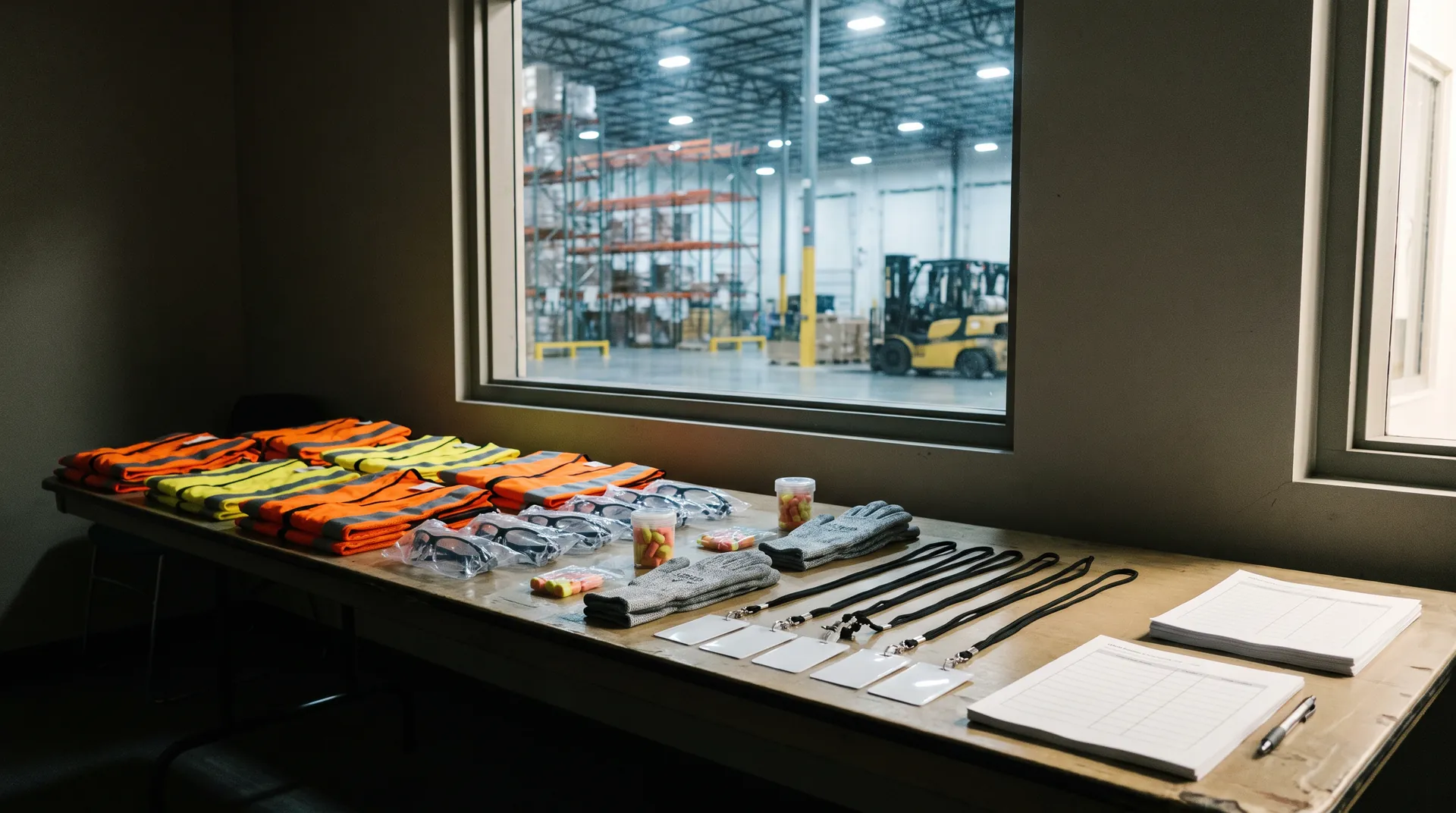
Whoever wins the rate card, your site still hands over the vest, runs the orientation and signs off the forklift evaluation, so safety reads the bid as well.
Walkthrough
A consumer-goods distributor with warehouses in Joliet, Illinois, Tukwila, Washington and Columbus, Ohio buys 412,000 temporary hours a year from one national firm at a flat-looking set of markups.
The contract, 12 months of timesheets from the VMS and the invoices. It finds what the renewal would otherwise leave alone.
Your site managers set the pay that fills a shift, checked against the BLS wage data for each metro, and the hours come from your timesheets. Every bidder prices this table, so pay stops being a variable.
| Site | Job family | Hours a year | Your pay | Metro median, BLS May 2025 | Burden per hour |
|---|---|---|---|---|---|
| Joliet, IL | Warehouse associate | 120,000 | $18.50 | $19.50 | $2.67 |
| Joliet, IL | Forklift operator | 40,000 | $21.50 | $23.05 | $3.08 |
| Joliet, IL | Office clerk | 20,000 | $20.00 | $22.28 | $2.21 |
| Tukwila, WA | Warehouse associate | 60,000 | $21.65 | $22.95 | $3.05 |
| Tukwila, WA | Forklift operator | 24,000 | $24.50 | $26.73 | $3.30 |
| Tukwila, WA | Office clerk | 8,000 | $24.00 | $25.62 | $2.52 |
| Columbus, OH | Warehouse associate | 96,000 | $18.25 | $19.81 | $2.37 |
| Columbus, OH | Forklift operator | 32,000 | $21.75 | $22.49 | $2.80 |
| Columbus, OH | Office clerk | 12,000 | $19.50 | $21.55 | $2.03 |
Job families follow BLS occupations 53-7062, 53-7051 and 43-9061. Metro medians are BLS figures for May 2025, for Chicago-Naperville-Elgin, Seattle-Tacoma-Bellevue and Columbus. Burden is itemized in the bid; Tukwila's workers' compensation uses Washington's published hourly classes and Columbus uses Ohio's published base rates, while Joliet's rates are the example's.
Each line becomes a field in the bid. A bidder can decline a line, and that shows too.
The incumbent first, then national firms and regional specialists your team approves. Your counsel, your safety lead and your site managers see the list before anyone is contacted.
Three bids on the same pay and hours. Bid B has the lowest markups and the lowest straight-time cost, and it stops being the lowest once its overtime rule, its wage steps and its conversion fee are priced.
| Bid AThe incumbent | Bid BNational firm | Bid CAdded by Zinit | |
|---|---|---|---|
| Markup: associate, forklift, clerk | 38%, 41%, 39% | 34%, 36%, 33% | 35%, 38%, 34% |
| Straight time, 379,040 hours | $10,530,578 | $10,191,797 | $10,287,955 |
| Overtime rule | 1.5 times the bill | 1.5 times the bill | Bill, pay premium and its burden |
| Overtime, 32,960 hours | $1,373,667 | $1,329,437 | $1,268,784 |
| When a wage step moves pay | Markup rides on the raise | Markup rides on the raise | Dollars, plus their burden |
| Tukwila floor and Illinois hour 720 | $182,580 | $176,612 | $149,630 |
| Conversion terms | Free after 520 hours | 12% of a year's pay until 1,040 hours | Free after 480 hours |
| 60 conversions at about 600 hours | $0 | $314,520 | $0 |
| Leveled total, one year | $12,086,825 | $12,012,366 | $11,706,369 |
| Fill commitment | 91% | 88% | 94% |
| Margin left on a forklift hour at Joliet, after the program fee and before any commission | $5.13 | $4.08 | $4.50 |
Bid AThe incumbent
Bid BNational firm
Bid CAdded by Zinit
Bill rate is pay times one plus the markup, to the cent. Overtime hours are 8% of every line. Wage steps: Tukwila's floor adds $0.80 an hour on all associate hours there, because the bids were priced on the 2026 floor. Joliet's move to the BLS median adds $1.00, $1.55 and $2.28 an hour on 30%, 40% and 50% of those lines' hours, which are the hours past a worker's 720th; the Illinois benefits equivalent comes on top and is the same under every bid in this example. Bid B's fee is 12% of 2,080 hours at a $21.00 average pay.
The total assumes every bid fills the same hours, which site operations will rightly question, so the fill commitment gets its own test before the award.
VERIFIED BENCHMARKS
| Category / Lever | Savings Range |
|---|---|
| Temporary and contract staffing (markup compression) | 10-20% |
| Permanent placement fees | 12-22% |
| Benefits administration competitive re-sourcing | 10-16% |
| Background screening and compliance | 12-18% |
| Training and learning services | 12-20% |
| HR technology competitive evaluation | 10-18% |
The American Staffing Association puts about 36% of staffing employees in industrial jobs, 24% in office and administrative work, 21% in professional and managerial roles, 11% in engineering, IT and science and 8% in health care, and the rate card changes with each. Beyond that, plenty of labor is bought under other names, and each name needs its own object.
| What you buy | How it prices | What a fair comparison holds constant | |
|---|---|---|---|
| Temporary staffing | A worker on the agency's payroll, directed by your site. | An hourly bill rate. | Pay, hours and job family by site. This page. |
| Statement-of-work labor | An outcome the supplier owns and manages. | Deliverables or a fixed fee. | Scope and acceptance. If your managers direct the individuals day to day, read it as staffing and show it to counsel. |
| RPO and permanent placement | Permanent hires, through a provider or a recruiter. | A fee for each hire, a share of first-year pay, or a program fee. | Hiring volume, time to fill and who owns the candidates. |
| Independent contractors | A person in business for themselves. | Whatever the contract sets. | Classification first. BLS counted 11.9 million in July 2023, and the federal test is under proposed revision. |
| MSP and VMS | A program that runs suppliers, or the software that does. | A commission on spend managed, a share of invoices, or a subscription. | Who funds it and where the fee sits. Published public programs show 0.85% to 2% before state fees. |
The same event runs for the rest of HR services: background screening on a per-package price list with court fees passed through, benefits administration per employee per month, permanent placement fees and training by the seat.
Some neighbors have pages of their own: IT staffing and managed IT services, call centers and business process outsourcing and payroll providers.
A company of any size usually buys from several of these, often through one program. Regional firms near each site are invited from the database, so they do not appear here by name.
light industrial, warehouse and office roles at scale


finance, engineering, science and technology contractors


travel nurses and allied health professionals


programs that run suppliers or hiring on your behalf


requisitions, timesheets and invoices for the extended workforce

Established suppliers in each category, shown to illustrate the market, not as a list of Zinit's customers or partners.
A mining customer's result across its recent RFPs and the logo row from the homepage, both as the rest of the site shows them.
Saved over 12% across 28 recent RFPs
A mining customer's recent RFPs, across its categories. The customer is not named.
RFPs published from






As shown on the homepage.
Zinit is supplier-funded and free to buyers: only the supplier your team selects as the winner pays a commission, the losing bidders pay nothing, and nothing is owed until you award. The commission rates are published openly on our site, and because the fee is tied to the award your team makes rather than to who competes, Zinit earns the same whichever qualified supplier you choose.
It can, the same way a supplier-funded VMS fee can, which is why the tab compares every bid at the all-in hourly bill rate, so whatever a bidder has built in shows in its number. It is also a different size, since under the fee schedule in Zinit's terms of service an award the size of the example's $11.71M carries a $5,000 flat fee plus 0.03% of the RFP volume, about $8,500 once, which is about 2 cents an hour over its 412,000 hours, against the 2.0% program fee that takes $0.59 from a forklift hour. If your CFO would rather keep it out of the bids altogether, the same terms let the buyer elect to carry the fee when the RFP is published.
No. Zinit runs the sourcing event for companies that buy staffing. It employs no temporary workers and places nobody, and it does not run your requisitions or timesheets.
Keep them. The event prices the rate card that goes back into your program, with the program fee stated inside every bill rate and each bidder's tier written into the schedule. Your program office signs off on the list, and the awarded card comes back as one table by job family and site for it to load into the VMS the way it already does. Published public programs show what those fees look like, from 0.85% in Michigan to 2% in Mississippi before state fees.
Not yet, and we would rather say so. The customer case on this page comes from other categories, so the fair way to test the ranges above is one job family at one site, on your own hours, before anything bigger.
Nothing moves because an event runs. The incumbent is invited first and prices the same card, and if it wins your team renews at the market's prices. If another firm wins, each bid has stated its transition terms by site, and your operations lead and counsel decide how and whether workers move.
It can, and that is the reason pay is fixed before bidding. Every bidder prices the pay your site managers say fills a shift, so a low bid has to come out of the supplier's margin and cannot quietly come from the worker. A bidder who thinks your pay will not fill says so in its bid, the margin left on an hour and the fill commitment both sit on the tab, and a bid that looks too thin to keep recruiters on your account is something your team can see before it awards.
No, that is your counsel's call. Zinit can lay out tenure by worker from your timesheets, keep W-2 and 1099 lines apart and flag hours approaching a stop like Illinois' 720, so your counsel starts from the facts.
No. Office, professional and healthcare staffing run the same way, each with its own job families, pay data and workers' compensation classes. The worked example uses a warehouse because that is where the pay steps, overtime and safety questions pile up.
Bring the rate card and 12 months of timesheets or invoices. Zinit builds your pay card and hours, runs the event and levels the bids over a year, with your team directing and approving every step.