Finds the long-lead lines
Power transformers, medium-voltage switchgear, generators, UPS and chillers, picked out of an equipment list or bill of materials in CSV or XLSX.
Before you go
One sharp email on procurement markets — what moved, why it matters, what to do about it. Daily or weekly. Unsubscribe anytime.
Free kit for data-center builds
A month of delay can cost a typical 60 MW US build as much as $14.2M, about $470K a day1, and power transformers now average 128 weeks from order to delivery2. Give this free kit your equipment list and it works out the latest safe date to order each long-lead item and flags the ones that will arrive late.
One universal skill. Works with your AI assistant.
 Claude
 ChatGPT
 Codex
 Gemini
 Grok
The download starts automatically. Use the button below if your browser asks you to start it.
Download the complete kitZIP · universal AI skill, Excel tracker, one-page cheat sheet and a fictional 40 MW exampleExtract the ZIP and open README.md. The tracker and the cheat sheet work straight away, and the README shows how to add the skill to Claude, ChatGPT, Codex, Gemini, Grok or another AI assistant and run the fictional 40 MW example first.
The skill writes report.html, long-lead-check.xlsx, analysis.json and summary.md where your assistant runs.
Sourcing a data-center build?
Zinit runs competitive tenders across the full data-center supply chain, with your team directing and approving every decision.
See Zinit for data centers →What lands in your hands
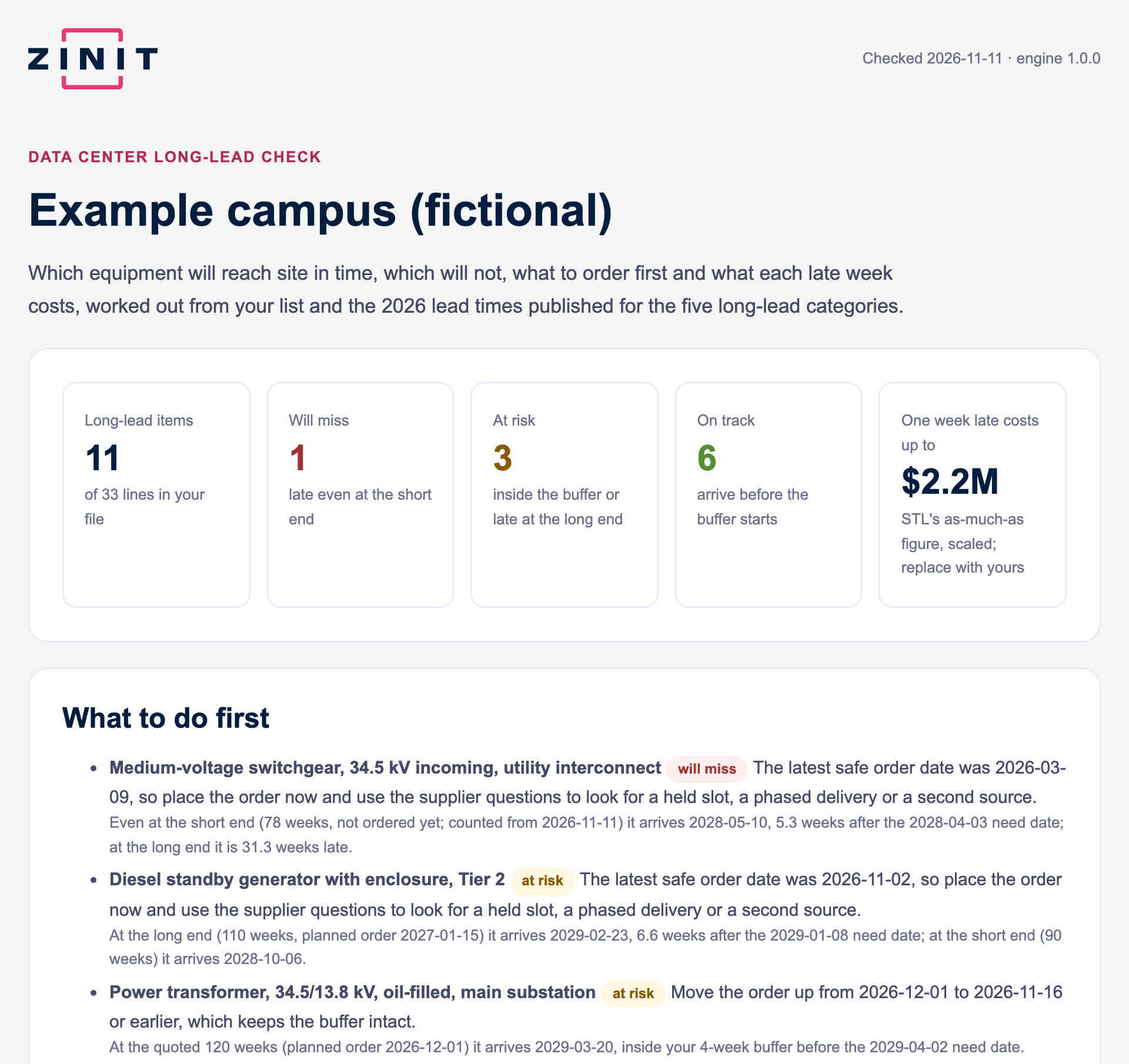
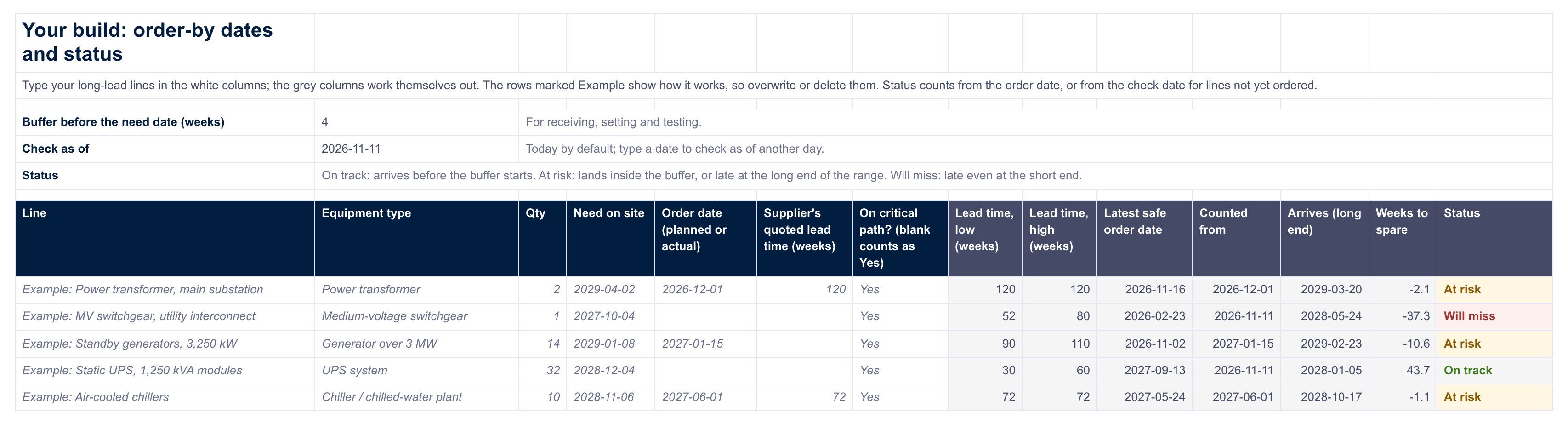
The report and the workbook are built from your own equipment list. These previews come from the kit’s fictional 40 MW example, so every date, price and line in them is made up.
What it does
Made for the procurement, supply-chain, project and construction managers and owner’s reps who plan data-center builds.
Power transformers, medium-voltage switchgear, generators, UPS and chillers, picked out of an equipment list or bill of materials in CSV or XLSX.
It counts back from the date you need the item on site, using the supplier’s quoted lead time or the 2026 published range plus a buffer for receiving and testing.
Every long-lead line gets a status of on track, at risk or will miss, with the weeks it has to spare or the weeks it will be late.
It scales STL Partners’ figure for a 60 MW build to the MW you give it and calls that an assumption, so you can swap in your own cost of a day.
A cheap quote that arrives late is easy to spot once its priced delay sits beside its price. It is a screening view, and the award stays your call.
Held production slots, phased delivery, standard ratings, factory test dates, freight and second sources, for every line at risk.
It writes an HTML report, an Excel workbook, JSON and a short summary, and it has no network, upload or telemetry code.
How it works
Step 1
One ZIP holds the AI skill, the Excel tracker, the cheat sheet and a fictional 40 MW equipment list to try first.
Step 2
Add the skill to Claude, ChatGPT, Codex, Gemini, Grok or another assistant that can run Python, attach your list as CSV or XLSX and tell it your build’s IT capacity in MW, or your own cost of a day of delay.
Step 3
The report puts the lines that will miss at the top, each with its latest safe order date and the questions to put to the supplier.
The lead times it checks against
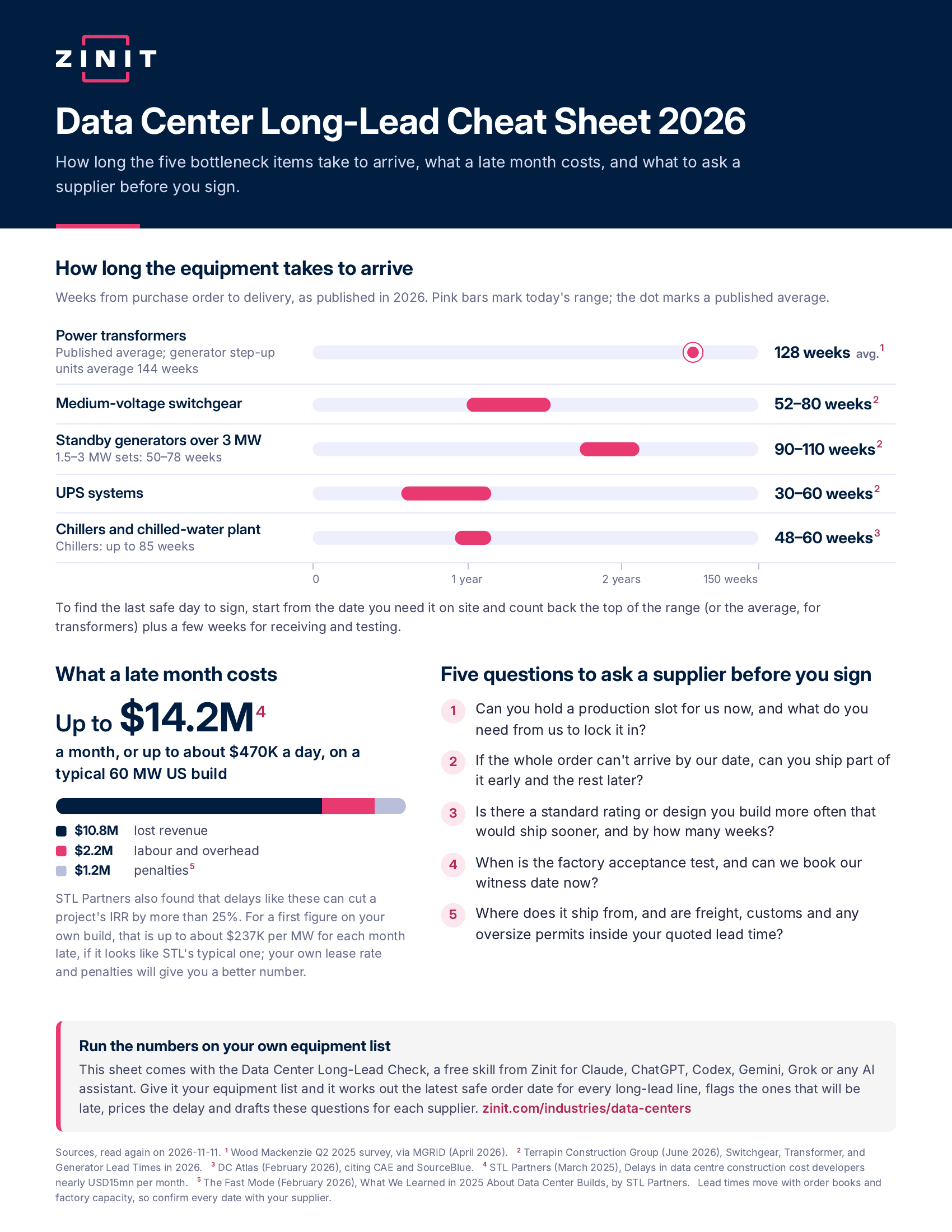
Weeks from purchase order to delivery, as published in 2026. The check counts back from your need-on-site date with the slow end of each range, and a lead time your supplier has quoted replaces the range.
Power transformers
Step-up units average 144, and the check uses 144 to stay safe128 weeks2
Medium-voltage switchgear
52–80 weeks3
Generators over 3 MW
90–110 weeks3
UPS systems
30–60 weeks3
Chillers and chilled-water plant
Chillers: up to 85 weeks48–60 weeks4
What’s inside the kit
data-center-long-lead-check/
The skill, for any AI assistant that can run Python: its instructions, the 2026 lead-time table with sources, and one Python script your assistant runs.
data-center-long-lead-check.zip
The same skill packed as one archive, for assistants that add a skill by upload, such as Claude.ai.
Data-Center-Long-Lead-Tracker-2026.xlsx
An Excel tracker with sheets for your build, the cost of delay, bid scoring, the lead times and their sources. It needs no AI.
Data-Center-Long-Lead-Cheat-Sheet-2026.pdf
One page to print or pin up, with the lead times, what a late month costs and five questions to ask a supplier.
example-bom-40mw.csv
A fictional 40 MW phase with made-up dates, prices and two competing transformer bids, so you can see a report before you use real data.
README.md
Setup for Claude, ChatGPT, Codex, Gemini CLI, Grok CLI and any other agent that can run Python, and how to run the check with Python alone.
Before you download
The Excel tracker works on its own in Excel, Google Sheets, Numbers or LibreOffice. You type your long-lead lines and the formulas work out the latest safe order date, the weeks to spare and a status, and the cheat sheet is a single page to print.
Any AI assistant that can read a skill and run Python. The README has setup steps for Claude, ChatGPT, Codex, Gemini and Grok, and for any other agent that can read files and run Python. We ran the fictional example and three harder made-up equipment lists in Claude Code, Codex, Gemini CLI and Grok CLI, and each one produced the same results as the script on its own. ChatGPT reads the same open skill format, according to OpenAI’s documentation, though we have not run the kit there ourselves.
This page never sees it, since the form asks only for your contact details. The skill’s script reads your file and writes four files where your assistant runs (your computer for a desktop agent, the assistant’s own workspace on the web), with no network, upload or telemetry code. Your AI assistant’s own account and data settings apply to anything you share with it, so check them before you give it a confidential list.
An equipment list, schedule or bill of materials as CSV or XLSX, one line per row. Only a description is required, and the answer gets sharper with quantities, need-on-site dates, order dates, quoted lead times, suppliers and prices. The kit explains which column names it recognises.
From figures published in 2026 by Wood Mackenzie (via MGRID), Terrapin Construction Group and DC Atlas, used as each source states them and listed with links in the kit. Lead times move with order books and factory capacity, so a quote from your supplier replaces the range, and every date is worth confirming.
It starts from STL Partners’ figure for a month of delay on a typical 60 MW US build and scales it in a straight line to the MW you give it. That is an assumption, so if you know your own cost of a day of delay, give it that and it uses your number instead.
It is a screening view that adds the priced delay to each price, so quotes can be compared on the same footing. Scope, specification, commercial terms and the supplier’s record still decide the award.
Yes, the kit includes a fictional 40 MW phase with made-up dates, prices and two transformer bids, so you can see the whole report before you share anything real.
Start with the fictional 40 MW example, then run your own equipment list and share the report with your project team.
Your download starts here after you submit the form. No phone number required.
Figures as each source published them. Lead times move with order books and factory capacity, so confirm every date with your supplier.