Build an Industrial-Consumables Category Plan
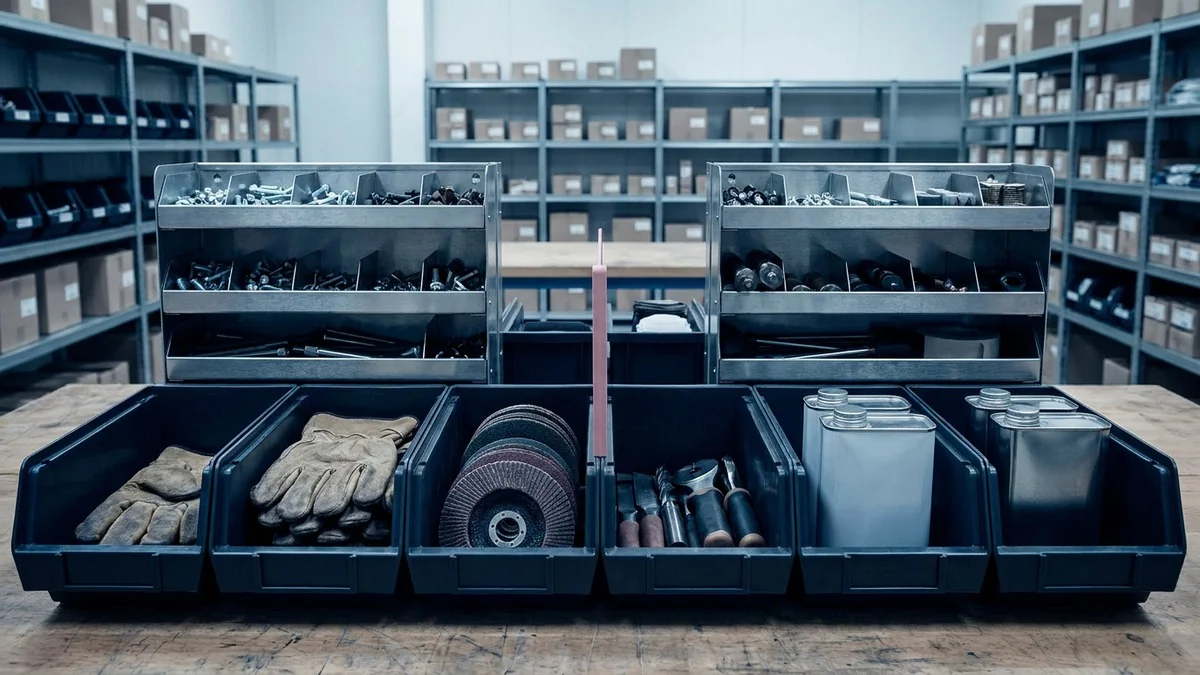
“I would want an agent to show who approved an item and why its local stock setting differs before it recommends a substitution.”
| Statistic | Source |
|---|---|
| A demand-forecasting study distinguishes delivery records from downstream demand information. | Original demand-forecasting research |
| A manufacturer case found differences in how VMI suppliers behaved around stock limits. | Original VMI supplier study |
| A quantity-discount model examines purchasing, inventory and capacity cost tradeoffs. | Original quantity-discount analysis |
| A published cooperative offer defines eligible purchases for its growth-discount mechanism. | Original Sourcewell contract and proposal |
| A manufacturing-process model connects resource inputs with process and output information. | Original UMP quarry case |
| US general-industry PPE rules connect selection to workplace hazards and fit. | OSHA general PPE requirements |
These sources cover different populations, periods and methods. They do not establish a common distributor margin, mandatory commercial service target, guaranteed consumption reduction or savings result. The contract is a dated public-cooperative example; applicable terms and eligibility need checking.
What belongs on the shared core list?
Start with the supplies that site owners can identify consistently: gloves, abrasive discs, cutting inserts, lubricants and cleaning materials used in repeat work. For each item, retain the manufacturer reference, buying and issue units, pack conversion, required specification and approved application. Ask the technical owner to review apparent duplicates and identify where product performance, equipment compatibility or operating conditions justify a separate item. Keep an unresolved match outside the approved consolidation until that review is complete.
PPE needs a safety review within the applicable workplace and regulatory scope. OSHA’s general-industry requirements connect selection with a workplace hazard assessment and proper fit, subject to the provision’s scope and relevant task-specific standards. Ask the site safety owner to confirm the required protection and fit before changing the approved item. A matching catalog description or lower unit price does not establish that approval; retain the actual assessment and selection evidence with the item record.
Give the shared list an accountable owner and a version that can be traced to the approval record. Retain the local item codes mapped to each approved product, including any different pack sizes or units. Ask each site to review the proposed mapping before changing its buying or storeroom references. For an exception, record the application, reason, approver and next review point so a later buyer can understand why the item remains separate.
How should sites connect usage and production?
Build the usage record around a defined process and observation period. The original UMP quarry case describes a structured representation linking material and consumable inputs, process specifications, equipment and output metrics. Its preliminary quarry implementation provides a useful modeling example with clear industry limits. For a factory pilot, ask the process owner which observed activity could explain an item’s use, retain that activity and its measurement basis beside the issue record, and validate the relationship locally before using it to set stock.
Keep the type of demand signal visible. Ducharme and colleagues’ published forecasting study uses a raw-liquid supplier’s delivery and downstream telemetry records from an earlier observation period to investigate missing demand information. That setting and method do not validate a conversion from a supplier shipment into factory consumption. Label a receipt, storeroom issue, return, measured use or model estimate accordingly, and investigate missing or inconsistent records before treating them as the site’s operating requirement.
Which replenishment decisions stay local?
Keep product approval separate from the proposed stock setting in the working register. Ask each site to document its operating schedule, storage constraints, delivery access, observed demand and replenishment lead time. Retain a local stocking decision where those inputs differ, even when sites use the same approved item. Have the site owner identify the response needed when the normal supply route cannot meet the work requirement, including who can authorize an emergency purchase or temporary alternative.
Compare delivery models against those responsibilities. Ask each bidder to describe what the buyer and supplier would do under a staffed storeroom, supplier replenishment service or point-of-use dispensing proposal. Retain counting frequency, stock visibility, access arrangements, replenishment triggers, stock ownership, maintenance obligations and the recovery procedure for a system outage. Where a dispensing record is offered as a demand signal, verify what it actually records and which returns, transfers or emergency issues sit outside it.
What should a distributor commit to?
Define service measures with the supplier and site owner before using them to rank offers. State whether the measure concerns an order, line or unit; which date starts and stops the clock; and how partial deliveries, approved changes and non-stock items are treated. Review stockout duration and replenishment response beside delivery performance. Set the proposed targets from the approved operating requirement and the supplier’s evidenced capability, with the comparison period and unresolved assumptions retained.
The VMI supplier study examines different replenishment behavior at a high-tech manufacturer and cautions that its classification method may not transfer to every buyer or sector. Use that limitation when assessing a proposal: request inventory trajectories and exception records for the intended arrangement rather than assume the same upper and lower limits will produce the same behavior across suppliers. Agree who reviews breaches, investigates causes and approves any revised stock setting; ownership and consignment terms also need explicit agreement.
How should price and rebate offers be compared?
Retain the commercial basis for every proposed item group. Identify the quoted net price or reference-price mechanism, freight and handling treatment, service charges, equipment fees and the process for changing the priced list. The published Sourcewell contract illustrates a cooperative arrangement with defined pricing and acquisition-cost provisions. Its public/nonprofit context and dated proposal make it an example for examining terms; it supplies neither a private buyer’s entitlement nor a national distributor contract-margin benchmark.
Ask finance to evaluate each proposed rebate against the approved demand plan. The incorporated Sourcewell proposal shows a growth-discount mechanism with a defined qualifying purchase basis that excludes specified charges, returns and credits. For the actual offer, record the eligible accounts and products, measurement period, baseline, exclusions, benefit timing and any alternative-program restrictions. Check the signed wording and current amendments, then distinguish a benefit available under that wording from an assumption about what the business will purchase.
The quantity-discount analysis by Ponte and colleagues models tradeoffs between purchase cost, inventory and capacity effects, and explicitly cannot supply a buyer’s own cost curve. Use that evidence to frame a local commercial review rather than claim a guaranteed result. Ask finance and operations to test any threshold-driven purchase against expected use, storage, expiry or obsolescence exposure and relevant handling costs. Record the decision to accept, renegotiate or decline the offer with the assumptions and authorized demand plan.
What should the category decision register contain?
Use the proposed register below to take a specific basket through review. Start with an identified site, application and supplier proposal, then retain the evidence and accountable decision for each field. Ask owners to leave missing inputs visible and resolve them before the affected change is approved. The register is authored procurement analysis; it is intended for local adaptation and has not been validated as a universal standard or savings method.
| Decision field | Evidence to retain | Accountable review |
|---|---|---|
| Product and application | Specification, approved use, technical or safety assessment | Technical or safety owner approves equivalence |
| Shared item mapping | Manufacturer reference, site codes, pack and issue-unit conversion | Category and site owners confirm the mapping |
| Local exception | Operating reason, affected site, approved alternative and review point | Named owner accepts or retires the exception |
| Usage signal | Receipt, issue, return or measured use; process and observation period | Process and stores owners confirm what the record measures |
| Stock and replenishment | Demand basis, lead time, trigger, limits and outage response | Site owner and supplier agree responsibilities |
| Service measurement | Unit of measurement, promised date, partial-delivery and exception rules | Operations reviews actual performance against the agreement |
| Price and incentive | Net-price basis, fees, qualifying demand, exclusions and benefit timing | Finance and contract owners review the total-cost scenario |
| Change and exit | Approval history, data access, stock ownership and transition duties | Authorized owners accept the commercial and operating change |
Authored expert analysis. Populate the register from the actual work, product approvals and supplier terms. It does not prescribe a universal service percentage, consumption allowance, distributor margin, legal clause or savings result.
How should a site pilot be reviewed?
Choose a bounded basket and observation period with the site owner, and document the starting conditions. Retain approved substitutions, emergency purchases, stockouts, returns and any change in workload or operating practice. Review the records with stores, production, safety where relevant, finance and the supplier. A change in issues or invoice spend needs investigation of those conditions before anyone attributes it to the new catalog or delivery model.
Carry the approved register and open questions into the structured RFQ workflow. Use the separate supplier-risk assessment for evidenced capability and delivery concerns. Before extending the arrangement, ask the responsible owners to accept the product mapping, local stock settings, service definitions and commercial treatment. Keep the evaluated version and its approval history available for later invoice, substitution and renewal reviews.
How should AI agents assist category planning?
Frequently asked questions
Can all sites use the same protective glove once it is on the core list?
OSHA’s general PPE provisions connect selection with assessed hazards and fit within their scope. The responsible safety owner must verify the item for the actual work and affected employees before approving a change.
Can a supplier’s delivery history stand in for measured consumption?
The original demand-forecasting paper treats delivery and downstream demand information as distinct signals. Record what the available data measures and validate any inference against the intended site application.
Does assigning stock limits make VMI performance uniform?
The original VMI study identifies differing supplier behavior in its manufacturer case and retains limits on transfer to other settings. Review actual inventory behavior and agreed responsibilities before relying on the proposed limits.
Should a growth rebate determine how much the sites purchase?
The quantity-discount model shows why price, inventory and capacity effects need joint examination under its assumptions. Use the approved demand plan and an accountable local cost review to evaluate the actual commercial offer.
Sources
- Understanding sustainability data through unit manufacturing process representations: a case study on stone production — Laurie Rebouillat; Ilaria Barletta; Bjorn Johansson; Mahesh Mani; William Z Bernstein; KC Morris; Kevin W Lyons, Procedia CIRP / Elsevier; original hosted by NIST, 2016. Foundational evidence (conference paper): Link resource/consumable inputs, process attributes and output metrics within an explicit process model.
- Improving demand forecasting for customers with missing downstream data in intermittent demand supply chains with supervised multivariate clustering — Corey Ducharme; Bruno Agard; Martin Trepanier, Journal of Forecasting / Wiley, 2024. Current empirical evidence (peer reviewed journal): Distinguish delivery records, downstream demand and missing-data inference; constrain transfer to industrial stores.
- Vendor-managed inventory in practice: understanding and mitigating the impact of supplier heterogeneity — Joep van den Bogaert; Willem van Jaarsveld, International Journal of Production Research / Taylor & Francis, 2021. Foundational evidence (peer reviewed journal): Supplier replenishment behavior can differ under inventory limits; compare inventory trajectories and record local stock responsibilities.
- 1910.132 - General requirements. — Occupational Safety and Health Administration, OSHA, 2016. Contextual evidence (official report): Workplace hazard assessment, appropriate PPE selection and proper fit constrain product rationalization.
- The effects of quantity discounts on supply chain performance: Looking through the Bullwhip lens — Borja Ponte; Julio Puche; Rafael Rosillo; David de la Fuente, Transportation Research Part E / Elsevier; original deposited in PMC, 2020. Foundational evidence (peer reviewed journal): Quantity-driven purchasing can change order patterns and create cost tradeoffs; proposed rebate review must use local inputs.
- Sourcewell Facility MRO contract091422-WWG, with incorporated Grainger proposal — Sourcewell; W.W. Grainger; Acklands-Grainger, Sourcewell, 2022. Historical evidence (official report): Specific published commercial example: core/hot-list pricing, total acquisition cost and a prospective growth-discount offer based on defined eligible purchases.